
“Includes transfers and accommodation in chosen regime. It does not include local fees.” The small print of the trips often contains this nuance that usually forces the visitor to find out if the destination to which it is directed has tourist taxes and what exactly is its amount.
The application of these fees is not homogeneous: neither all countries have them nor all their cities charge them, which makes the final calculation process of the cost of a trip even more confusing.
Sometimes used as a supposed deterrent in the attempt to curb mass tourism, the imposition of this levy is usually in the hands of local and regional authorities. These are the ones who decide if they charge the fee to the tourist who spends the night in their Accommodations and if the amounts of the same vary each year.
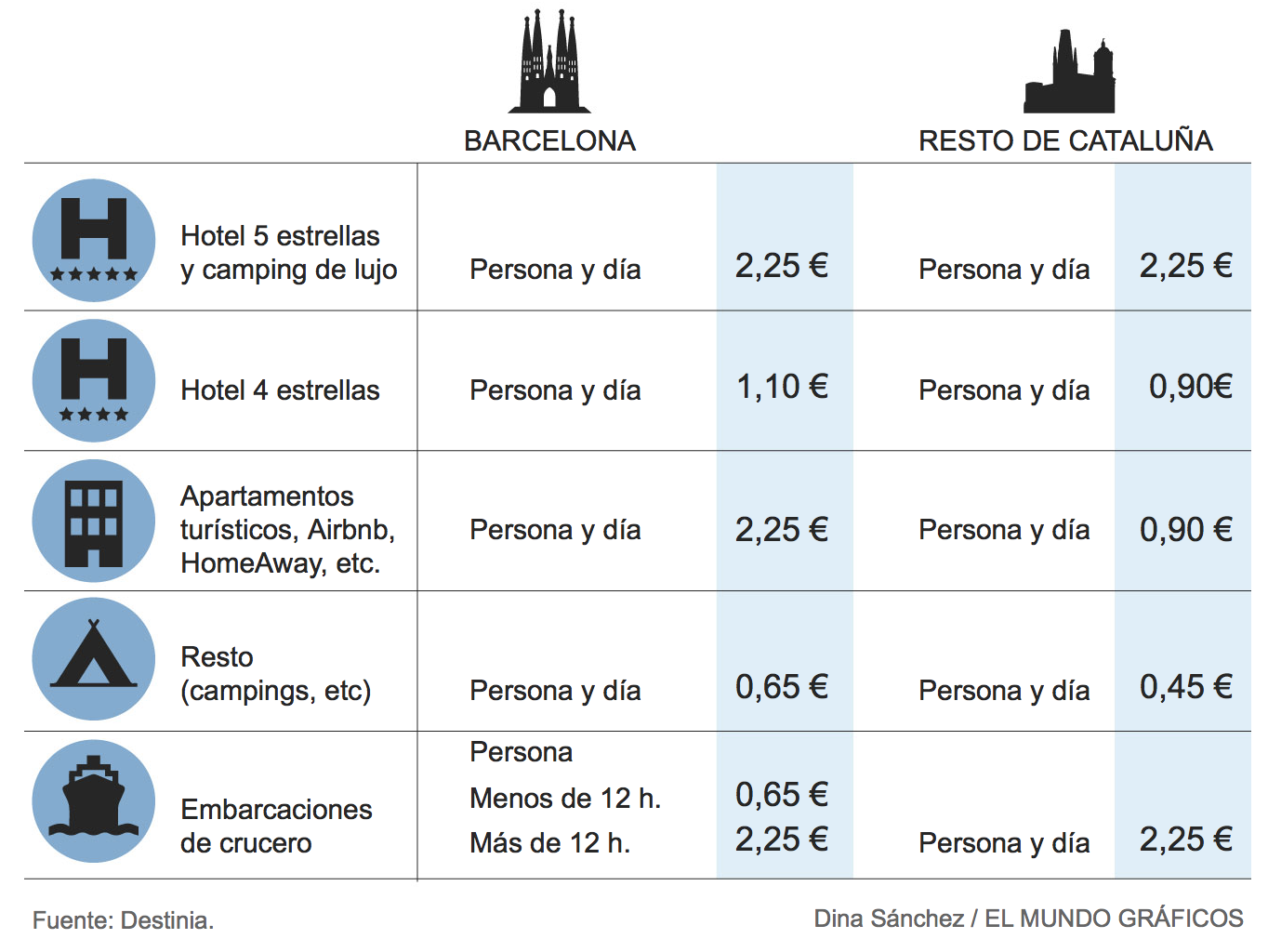
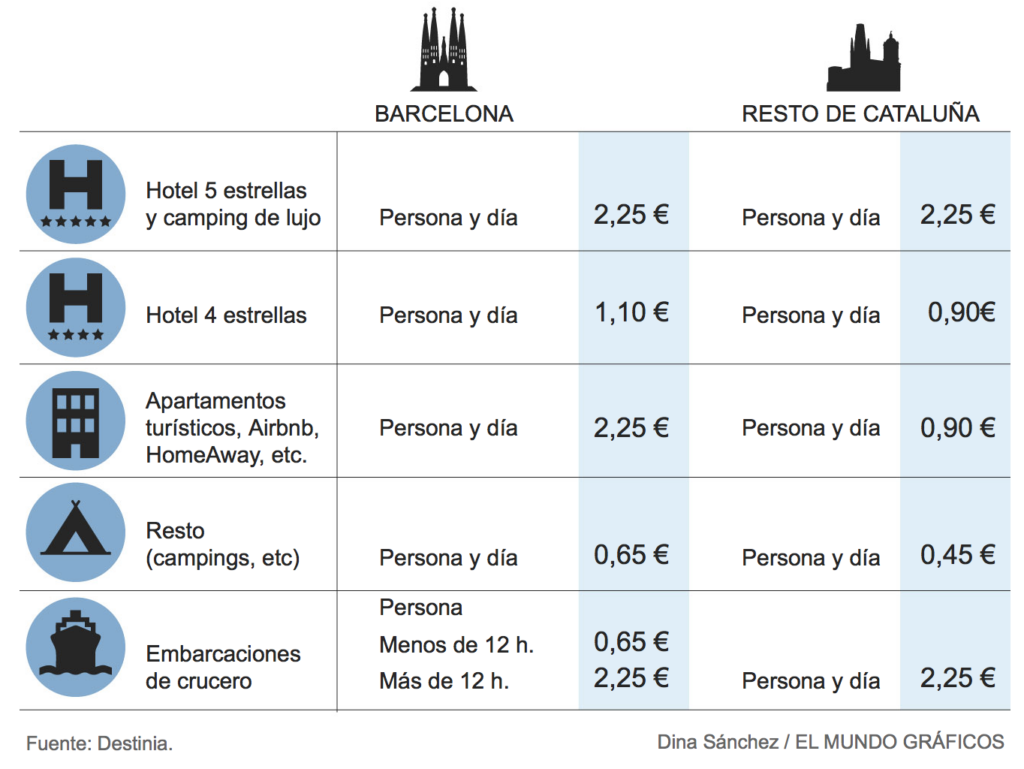 These are some of the amounts and cities in which tourists pay local taxes, already in the form of ecotasses or city tax, collected by the online travel agency Destinia.
Catalonia
Within Spain, two communities mainly impose tourist taxes: Catalonia and Balearic Islands.
The Catalan Generalitat maintains a tax for tourists staying in the city of Barcelona that goes from 2.25 euros per person per day if you stay in a five-star hotel or luxury camping at 0.65 euros for those who do so in other establishments other than hotels or tourist apartments.
Therefore, those who have chosen the option to stay through Airbnb or another Holiday rental platform are not spared, since in Barcelona they will also pay 2.25 euros for Night, explains Destinia.
In any other Catalan town the fee ranges from 0.45 to 2.25 euros. With 0.90 euros for stays in Properties of Holiday rental.
Of course, in Catalonia legally you can only charge for a maximum of a stay of seven days.
Being on a cruise is also free of the rate: the boats pay for mooring in any port of the territory of Catalonia, and the amounts are depending on the duration.
Of these payments are exempt social travel programs subsidized by the Public Administration, and stays for health reasons, in addition to travelers under 17 years.
Balearic Islands Islands
They imposed their ecotax in 2016. And this year they have changed the tax, doubling the rate and changing the way they apply it. In 2018 the Balearic Government has set two bonuses on the rate: one of 75for those traveling in Low season, that is between November 1 and April 30, and another 50for long stays from the ninth day.
A maximum of four euros and a minimum of two is paid for Night depending on the categories of the Accommodation, regardless of whether it is hotel, apartment or tourist property, according to the compilation of the travel agency.
The cruise passengers also pay. Specifically, two euros.
Europe
More destinations than seem to tax tourists in Europe who visit them. Among the cities of northern Europe is the case of Amsterdam or Berlin, in which a percentage of the Price of the room is paid. In the Dutch capital, it has risen this year by 1, so the tourist tax stands at 6, while in the German one it amounts to 5that can be applied to a maximum of 21 days of stay.
In Belgium, most of their cities have had a city tax on Tourism since 2017. And in its capital, Brussels, it is four euros per room, which is three euros in the case of Airbnb and campsites.
Paris and Budapest keep unchanged the rate they had last year. Between one and two euros visitors to the Central European city pay depending on the district where the Accommodation is located and 4% of the Price if it is the urban center. The also Central European Prague and Vienna also charge fees for Accommodation. And for Parisian tourists, the extra charge goes from 0.22 euros in a campsite to 4.40 euros in a palace, with the exemption of children under 18.
Children under 13 do not pay in the two major Portuguese cities, Lisbon and Porto. Where the usual extra cost for the tourist is between one and two euros, exempt those displaced by medical reasons and people with a disability of 60or more.
In Italy, Rome, Milan and the overflowing Venice apply various costs to tourists. Two to seven euros per person and Night in a Roman or Milanese hotel. And between one and five euros in hotels in the center of Venice, with exceptions of minors in some cases.
London, like Madrid, resists imposing a tax on the tourist, but in the British capital already put on the table a proposal of about 2.80 euros for Night, recalls Destinia.
Sweden has been the last to adopt a tax on travel. In this it is almost an amount of 39 euros per plane passenger that takes off from a Swedish airport that has been applied since last April with the aim of minimizing the impact of CO2 emissions.
Source: ElMundo.es