
It will differentiate between habitual residence and rental properties all year round to give tourist places in Mallorca.
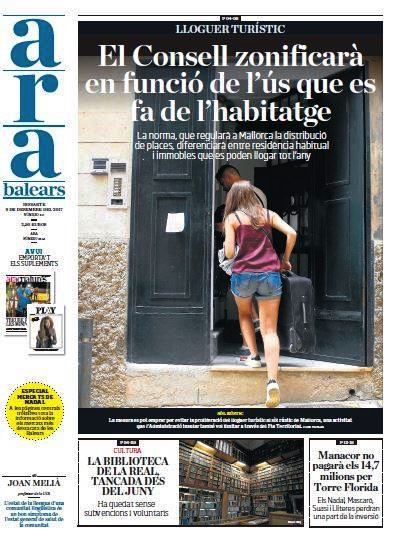 The zoning in which the Council of Mallorca is working to regulate which municipalities of the island can create new places of Tourist rental will differentiate between three types of Property: the multi-family -a flat in a farm, for example- that can be rented all the year, the single-family -like a xalet- that can be rented all year round and the properties of any type that are only rented for 60 days because they are the usual residence of their owner. Thus, according to sources of the Council, when regulating where it is allowed to grant new places of Tourist rental will not only take into account the typology of the Property – if it is isolated, in the middle of an urban center, within a building with neighbors …- but also the use that is made.
It is a tool that could be used by the Council to, for example, allow new Tourist rental places in a municipality, but limiting this activity temporarily -only the usual Property can be rented two months a year – and making it possible to rent only if the person who owns lives.
In this way, practices denounced by the groups in defense of the Property would be avoided, such as the purchase of entire buildings to rehabilitate them and then rent them to tourists by Prices much higher than when they were in the long-term rental market. It could also be used to avoid the touristization of the rustic soil, which is, in fact, one of the objectives of the Council of Mallorca with the modification of the Territorial Plan of Mallorca in which it is currently working. In recent years, single-family properties have proliferated that are rented to tourists on rustic soil and condition the creation of new places to make it a habitual residence would limit the existence of large Owners who are dedicated exclusively to renting their homes.
The way in which the three types of Property will be distributed has not yet transcended, but will be combined with the six types of area in which the island will be divided: common rustic soil, protected rustic soil, saturated coastal areas, unsaturated coastal areas, saturated urban areas and unsaturated urban areas.
Thus, the Council can regulate considering areas such as Cala Millor a saturated coastal space and prohibit the Tourist rental in properties that you want to rent throughout the year – although all those who have a license since before the approval of the law are excluded from this new regulation.
To demonstrate that a Property is the habitual residence of a person it will be necessary to show the certificate of registration, but some environmental groups believe that this can be a trap for the Administration if, for example, the different members of the same family that live together they registered in different homes to be able to rent those Properties as if it were their habitual residence.
In addition, from the island institution they must coordinate with the City of Palma, which elaborates its own zoning but must be agreed with the Council to distribute where the new tourist squares can grow. Currently, Mallorca has a bag of 43,000 tourist places still to distribute among all tourist establishments, but through the PIAT (Intervention Plan in Tourist Fields) or the PTI (Insular Territorial Plans), the Tips can grow or decrease this roof of squares. Regardless of the decision, the island institution and Corte must decide which of these possible new places remain in Palma and according to what distribution criteria.
The Council is committed to submitting a zoning proposal before the end of the year and, although it will not yet be presented in the plenary next week, they do hope to have a first wording to negotiate between the Covenant before January. In Palma, on the other hand, the tempos will be tighter, but from Cort they assure that they want to have the zoning finished before July, the limit set.
Source: AraBalears.cat