
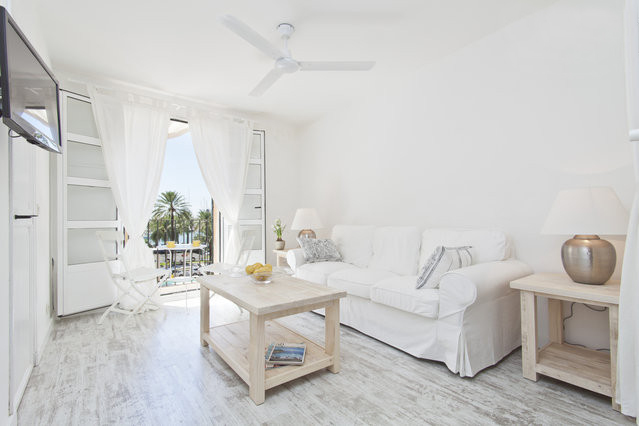
 While important European cities tend to establish lax regulations to rent properties for tourist use, in Madrid and Barcelona a more restrictive regulation is imposed that threatens the business, say the advocates of the collaborative economy. They also call for a single policy for the state. Currently, the regulation is regional or municipal. Only in the capital and in Barcelona there are tens of thousands of Tourist rental properties.
The business of the Properties for Tourist rental rental has grown exponentially in recent years, for three reasons, mainly: the demand of the consumer (tourist); the technological development that allows it through the platforms of Bookings; and the economic situation, which favors more people to seek to obtain performance to assets in disuse or idle. To show the growth of the sector in the world, an example is enough: the leading platform in promotion of private tourist Accommodations, Airbnb If we take into account only the last two years, the number of Propertys multiplied by five, from 10 million in 2013 to 50 million in 2015.
However, the two largest Spanish cities – and two of those that receive the most visitors each year – have established a rigid regulation, which has received criticism from the defenders of the collaborative economy. Barcelona says that it does so to protect the neighbors from annoying noises and Madrid listening to the pressures of the traditional hotel sector, which denounces most of these Accommodations of clandestines.
Barcelona says it does so to protect neighbors from annoying noise; Madrid has heard the claims of the traditional hotel sector
The regulatory policy of the two large Spanish cities differs markedly from that of cities such as London, which in 2015 changed the rule that prohibited residents from renting their Properties; that of Paris, which in 2014 approved that anyone living in France and having a Property can rent it without having to ask for a specific permit from the city council -as long as that is their usual property, as well as short stays in the second residences-; the Italian region of LombardyIt is a professional activity and that people can rent their homes without the need for the requirements that professionals must face.
In Spain, the phenomenon has come strongly: the volume of Airbnb customers, for example, multiplied by 17 in three years in the country. From the 80,000 Spaniards who used this platform in 2012, to the 1,360,000 estimated to have used it in 2015. Airbnb says it has about 100,000 ads in Spain, of which 16,000 would correspond to Barcelona and 7,000 would be concentrated in Madrid.
Competition disapproves of it
Criticisms of the regulation of the Community of Madrid came even from the National Commission of Markets and Competition (CNMC), which filed a contentious-administrative appeal against the regional decree that regulates the activity of Propertys for tourist use, both in the autonomy of Madrid and that of Canary Islands. The CNMC still did not have information about a Justice response.
Barcelona, the Spanish tourist city par excellence (Catalonia received 16.8 million foreign tourists in 2014, compared to 4.5 million in Madrid, according to data from the official Frontur survey) had a real problem in containing tourists with uncivic behaviors and the complaints of the neighbors were a fundamental element when it came to the municipal government deciding to act.
In Madrid, although with less influx of tourists than Barcelona, demand also increased. However, the Tourism that attracts the capital is quite different, in general, from that of Barcelona. The lack of beach in Madrid means that there are fewer tourists but also a quieter profile: they are usually more interested in culture and less for Night. Although there are associations that have expressed complaints against annoying noises, the situation is incomparable in magnitude to that of the Catalan capital. According to a study by the University of Salamanca -the Barometer of Holiday Accommodation in Spain, prepared on behalf of the HomeAway platform-, tourist properties do not generate a higher level of conflict than hotels: 97.02of users have not had problems with neighbors, compared to 96.80of hotel users who have not had problems with other guests.
Criticism of rigidity
Despite the relative scarcity of problems in this regard, at the beginning of 2015, the Community of Madrid published the decree that regulates the activity of tourist apartments establishing a minimum of five days to rent this type of Property. The regional government inaugurated 2016 by fining the Owners of about fifty Properties.
It was short of criticism, considering that Madrid, being a capital of urban Tourism, it seems unlikely that there are many tourists willing to stay so long.
It is a nonsense that in Madrid five days are required, this is only explained as a measure to protect the hotel industry,” José Luis Zimmermann, director of Sharing Spain, an association that is defined as a “collective of companies that was born within the Spanish Association of the Digital Economy (Adigital) with the aim of analyzing and disseminating the impact that the collaborative economy and the business models “peer to peer” have
Zimmermann understands it as a cession to pressure from the traditional hotel industry. “The pressure of an industry that brings together 10of GDP is forcing the autonomous communities and legislators to pass decrees and regulations that prevent the growth of these platforms, when we do not see that they are unfair competition or that they ‘eat’ the business to traditional hospitality.”
Contacted by bez.es, the hotel management CEHAT did not manifest itself in this regard.
For the president of Sharing Spain – which integrate, among other companies, offers companies of Tourist Properties such as Airbnb or Home Away, among others – the “obligation to be in a register of Property for vacation use may be reasonable, the same as applying a fee, but you have to assess that they are the same throughout the territory.”
Unified regulation is missing
That is precisely one of the great problems of Spain in this matter: the lack of a unified regulation at the state level. “The main difficulty we face as a global platform is the disparity of criteria from one autonomous community to another: we find ourselves with flexible and consensual regulations, and with others that suppose the de facto prohibition of the activity, we are in favor of a homogeneous and easy-to-compliance regulation that frames this activity to grant greater legal certaintyfrom the platform Home Away (affiliate of the multinational Expedia), which invoiced 446.8 million euros in 2014, although it said it does not have income figures in Spain, where it has 88,000 accommodation ads.
“It is obvious that restrictive regulations will inevitably drive greater opacity, which is precisely what they are trying to avoid. Regulation must prioritize the general interest and market unity, not the interest of a small group of economic actors with enormous power and influence,” HomeAway said.
According to the conclusions of the aforementioned Barometer, the Tourist Property has generated an economic impact in Spain of about 4,300 million euros in the last two years, of which 3,408 million were destined for leisure and food during the stay.
Source: Bez.es